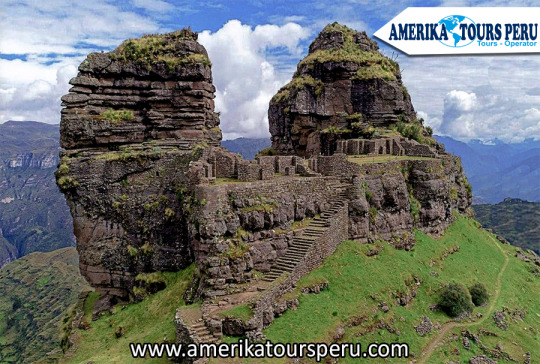
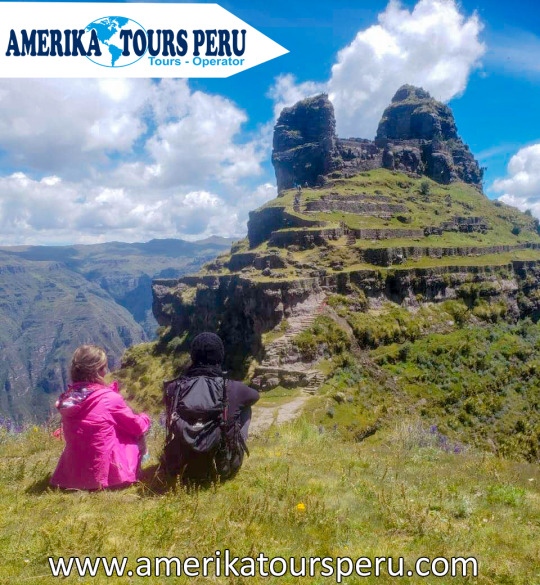
Waqrapukara is a new tourist attraction that remains almost unknown until today. The tour is suitable for those seeking a spirituality that is drowned in the sea of commercial tours. Waqrapukara is a pre-Inca archaeological complex located in the Acomayo province within the Cusco region, near the Apurímac River. The main construction is located on platforms, squares and a so-called «Bosque de Piedras». From its height of 4,140 meters above sea level, it offers spectacular views of the Apurímac River and the Andes.
WAQRAPUKARA TOUR ITINERARY
Its name comes from Quechua, "waqra" means horn, while "pukara" means fortress. Therefore, the meaning of the name translates as a "horned fortress" given by its typical form. However, the locals also called it "Llamapukara", as they claim that the shape does not represent horns, but ears of a lama.
It was built by the pre-Inca Qanchis culture in the period called "Auqaruna" (1,500 BC - 1,000 BC). During this period, the complex was a city called "Llaqta Pukara" and home to a leader of the Yankees. It also served as an astronomical observatory and sanctuary for the god "Teqci Pachakamaq Wiraqocha" (a creator of all created things). Subsequently, it was conquered by the Incas, who have molded the buildings to geography during the reign of Wayna Qhapaq. Then it became a first-class Inca sanctuary that symbolizes an immense political and religious power that has not yet been confused. In 2017, the complex was declared Cultural Heritage of the Nation by the Ministry of Culture of Peru.
Waqrapukara Archaeological Complex. Cultural Heritage of the Nation of 2017.
It was built by the Qinchas and later conquered by the Incas. The building is located on platforms, squares and a stone forest, it would be an Inca sanctuary. Waqrapukara has a privileged view of the Apurímac River.
Waqrapucara details
Maximum Altitude: 4,140 meters / 13,580 feet
Minimum Altitude: 3,096 meters / 10,157 feet
Duration of the walk: 6 hours
Trekking distance: 15 km / 9.3 miles
Difficulty: Moderate
Weather: Cold
Waqrapukara is the archaeological monument located in Acos, Acomayo province in Cuzco, which has been declared a National Cultural Heritage by the Vice Minister of Cultural Property. This Inca monument is located on the slopes of Mount Kenter, has a privileged view of the Apurímac River and has two groups of buildings.
The first group is located at the top, in the middle of a rocky dam, where you can see two enclosures separated by a wide central space. The enclosures have halls, ornamental niches and doors with double jambs; its architecture seems to be similar to that of other ceremonial buildings.
The second enclosure is located at the bottom, and has 8 platforms 153 meters long and 1.80 meters high, which correspond to the topography of the terrain.
Some inhabitants of Acos also call it Llamapukara; and although its origins go back to pre-Inca times, its foundations were built by the Q’anchi, and the Inca construction was built during the sovereign period of the Tahuantinsuyo Wayna Qhapaq. MORE CUSCO TOURS.
Waqrapukara is a new tourist attraction that remains almost unknown until today. The tour is suitable for those seeking a spirituality that drowns in the sea of commercial tours. Waqrapukara is a pre-Inca archaeological complex located in the province of Acomayo within the region of Cusco, near the Apurimac River. The main building is located on platforms, squares and a so-called "Stone Forest". From its height of 4,140 m.a.s.l., it offers spectacular views of the Apurimac River and the Andes.
Its name comes from Quechua, "waqra" means horn, while "pukara" means strength. Therefore, the meaning of the name is translated as a "fortress with horns" given by its typical form. However, the locals also called it "Llamapukara", since they claim that the shape does not represent horns, but ears of a lama.
It was built by the pre-Inca Qanchis culture in the period called "Auqaruna" (1,500 BC - 1,000 BC). During this period, the complex was a city called “Llaqta Pukara” and headquarters of a leader of the qanquis. It also served as an astronomical observatory and sanctuary of the god "Teqci Pachakamaq Wiraqocha" (a creator of all created things). Later, it was conquered by the Incas, who have molded the constructions to geography during the reign of Wayna Qhapaq. Then it became a first-class Inca sanctuary that symbolizes an immense political and religious power that has not yet been baffled. In 2017, the complex was declared Cultural Heritage of the Nation by the Ministry of Culture of Peru.
Waqrapukara Archaeological Complex. Cultural Heritage of the Nation of 2017.
It was built by the Qinchas and then conquered by the Incas. The building is located on platforms, squares and a stone forest, it would be an Inca sanctuary. Waqrapukara has a privileged view of the Apurimac River.
In runasimi "waqra" is horn and "pukara" is the equivalent of strength. Seeing the picture the name is more than eloquent. But the shepherds of the communities of Acos, to the south of the city of Cusco, also know him as Llamapukara: “they are not horns - they assure - they are the ears of a flame that is alert to the presence of foreigners”.
Despite its almost impregnable location - at the top of a peak over the chasms that overlook the Apurimac River canyon and over 4 thousand meters above sea level - at least four old roads lead to this fortress.
Undoubtedly, both "ears" or "horns" found in the fortress were cause for sacralization among its builders. The best preserved are its walls, stairs, terraces and finely carved stone rooms in the best classic Inca style.
For archaeologist Miguel Cornejo, Waqrapukara represents the “architecture of power. It is a first-class Inca sanctuary, which denotes immense political and religious power not yet deciphered, ”says Cornejo. “Before entering Waqrapukara, you reach a space formed by river and wind erosion. The whole natural environment warns from afar that a special place, out of the ordinary, of incomparable beauty is being reached, ”adds the PUCP archaeologist.
Waqrapukara is a good adventure and experiential tourism destination. The truth is that this route does not ask for tourists, it requires expeditionaries.
Unlike other destinations with many visitors, you can camp in the surrounding area in Waqrapukara. I recommend enjoying the night sky. You may find the reason why your former builders chose this magical and mysterious place.
How to get?
One of the routes to reach the Waqrapukara fortress is to go to the Pomacanchi district, province of Acomayo, which is approximately 115 km from the city of Cusco.
Arriving at the Chuquicahuana bridge, which is 92 km away, we head down the road to Acomayo. Arriving at the place called Cebadapata, we find the Pomacanchi Lagoon, which is the first tourist attraction, in this lagoon we can observe fishermen in small boats doing their daily work and the natural landscape with all the fauna and flora of the place.
In front of Cebadapata we can find the archaeological remains of K’ero, bastions, pre-Hispanic andenería, colcas and other constructions. In this way we arrive at Pomacanchi, the Ecotourism Capital of the Cusco Region, in this town we will find the house of Carmen Rosa Noguera, mother of the Caudillo José Gabriel Condorcanqui “Tupac Amaru”, who as we know started the Latin American Independence Revolution.
Why do some promote traveling to Waqrapukara through Pomacanchi?
Because we find attractive places, not only for the archeological remains of K'ero, the pre-Inca constructions in Conchacalla, the Pomacanchi Lagoon, the Huaca de K'ullupata, the vicuna reserve of Pumawasi but also for the fauna and flora, we will find species native such as achanqaray, qantu, chillka, t'ankar, ich'u, qeto qeto, panti, totora and other species. In the fauna we will find: Falcon, kestrel, eagle, condors, vicuñas, puma, deer, fox, skunk. The other advantage is that Pomacanchi is a colonial-style villa, as evidenced by its colonial bridges distributed throughout the district, its church also has accommodations for the traveler, such as the Municipal Lodging that has a dining room. On the way to the fortress we can enjoy the abundant wild vegetation of the area, spectacular view of the Apurimac Canyon and many other beauties.
Undoubtedly, both "ears" or "horns" found in the fortress were cause for sacralization among its builders. The best preserved are its walls, stairs, terraces and finely carved stone rooms in the best classic Inca style.
For archaeologist Miguel Cornejo, Waqrapukara represents the “architecture of power. It is a first-class Inca sanctuary, which denotes immense political and religious power not yet deciphered, ”says Cornejo. “Before entering Waqrapukara, you reach a space formed by river and wind erosion. The whole natural environment warns from afar that a special place, out of the ordinary, of incomparable beauty is being reached, ”adds the PUCP archaeologist.
Waqrapukara is a good adventure and experiential tourism destination. The truth is that this route does not ask for tourists, it requires expeditionaries.
Unlike other destinations with many visitors, you can camp in the surrounding area in Waqrapukara. I recommend enjoying the night sky. You may find the reason why your former builders chose this magical and mysterious place.