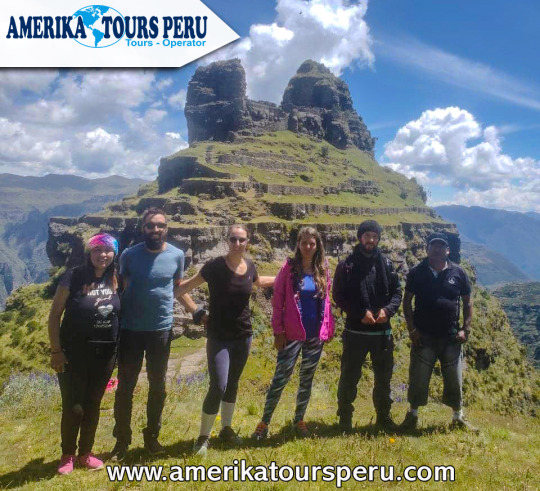
Once again the region of Cusco surprises us with a new wonder in its territory, the wonders that this region possesses are incalculable since it was the cradle of the vast and majestic Inca Empire, what we have left is to delight our view, to be amazed at the great architectural ingenuity of the Incas and of course take care of these wonders, the great legacy left to us by these fascinating men, now it's time to admire the mysterious wonder of Waqrapucara.
The name Waqrapukara comes from the Quechua voices: Waqra which means "horn" and Pukara which means "Fortress", we can deduce then that Waqrapukara means "Fortress of the horns", but there is an observation of this interpretation by the locals that indicate that the fortress has no horns, but that they are “the ears of a flame” adducing that it is always alert to what happens around it, therefore, they call it “Llamapukara”
The curves on the carved stone terraces seem to hold the Waqra, which resembles a double-billed crown. In the middle of it, there is a natural cave with Inca intervention and a small window that overlooks the abyss, which also allows a magnificent view of the night sky, populated with constellations, planets and stars of enormous value in the Inca worldview. It is at the top of a huge forest-covered ravine that crowns the chasms that overlook the Apurimac river canyon, the archaeological monument is surrounded by impressive platforms, squares and a forest of stones that resemble thrones, with mythological giants contemplating the mountain landscape.
You can do the tour to Wacrapukara through a walk that lasts about 1 hour and a half, whose difficulty is medium, it is not difficult and the effort will always be worth it when you get to observe the incredible architectural beauty, you can also do mountain biking since the nature of the place lends itself to this activity.
It was considered Cultural Patrimony of the Nation in 2017, we can affirm that Waqrapukara has nothing to envy to the best cultural tourism, adventure and high mountain destinations as well as an archaeological monument is a wonder, but we must add the landscape impact of its surroundings and the spectacular stone formations, when you arrive, the first thing is the astonishment, the landscape that surrounds Waqrapukara is one of the most spectacular in the Andean world. The high plateau wasteland is interrupted by the edges of an immense canyon. Fierce gusts of wind rise through the chasms forming capricious figures on the tops of the ravine. The Inca architects sought to dominate the landscape without transforming its spectacularity.
Forced by circumstances - competition, mass tourism - Cusco operators point to the south, whose quality destinations are only visible. However, years ago, visionary agencies such as Pukupuku Travel (Facebook Pukupuku Travel) explored that territory and positioned new routes long before the Sacred Valley overcame. http://bit.ly/amerikatoursperu
Needless to say, we did not enjoy the cosmopolitan Cusco night, because at 4 in the morning he picked us up from the Ricardo Reátegui Hotel (T. 959136848), one of the top guides in the region. It was cold in Huayqui, the starting point, but as soon as we started beating for a majestic puna we went into heat. We do not cross any tourist, only shepherds taking care of their flocks, and this route is more for travelers in search of spirituality drowned in commercial tours.
Suddenly, an amazing hollow interrupts the altiplanic plain. With astonishment, the archaeologist Miguel Cornejo tells him, who investigated the place in 2010: “Before entering Waqrapukara, you reach a space formed by river and wind erosion. The whole natural environment warns that a special place, out of the ordinary, of incomparable beauty is being reached ”.
The abyss that forms the Apurimac River is the cherry of the cake and makes Waqrapukara (4,104 m.a.s.l.) one of the most spectacular landscapes in the Andes. Inca architects molded their buildings to geography. "It is a first-class Inca sanctuary, which denotes immense political and religious power not yet deciphered," adds Cornejo.