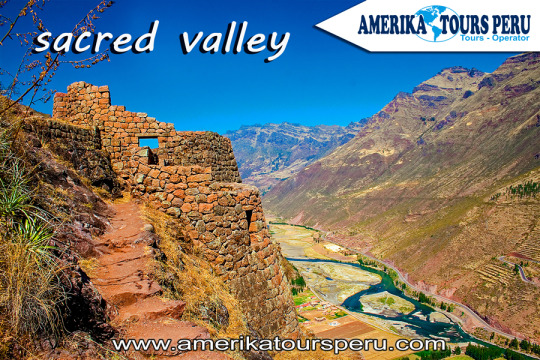
Named for being the main food supplier of the Inca empire, The Sacred Valley sits on the banks of the Urubamba River. This river in its beginnings has the name of Vilcanota, which comes from the Quechua word Wilcamayu or Sacred River. The Incas built archeological centers, along its banks, which replicated the constellations they knew of the Andean sky so that this contributes, even more, to the beauty of this charming valley.
The Sacred Valley of the Incas is located 35 kilometers from Cusco, and about 600 meters below the level of Cusco. It covers the part of the Vilcanota river basin between the towns of Písac and Ollantaytambo.
Between the months of April and October, at night the temperature drops considerably, in the early hours of the morning the tempreratura rises gradually until after noon.
Here are some suggestions of what you can do in the Sacred Valley
Canoeing in the sacred river of the Incas (Huillcamayo or Vilcanota). Appreciate and buy handicrafts at the famous craft fairs in Pisac, Ollantaytambo and Chinchero. Tour Moray, impressive agricultural laboratory of the Incas.
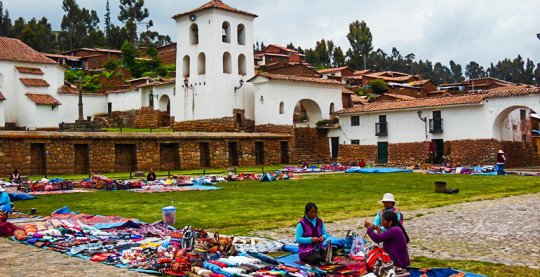
Chinchero known as the city of Arco Iris is located 28 km. to the northwest of the city of Cusco, on the 3160 msnm., flanked by the snowed ones of Salkantay, Verónica and Soray. The view from here is impressive. Chinchero belongs to the province of Urubamba, department of Cusco
Chinchero, the most typical population of the Sacred Valley of the Incas, is a distinctly Inca city that the conquistadores wanted to "civilize" to implant their culture, but never fully achieved it. Its inhabitants inhabit almost intact Inca buildings, in the same place where their distant ancestors lived and formed the largest and most prosperous civilization in America.
In the Archeological Site of Chinchero, its platforms are initially called, which allows us to understand that it was a center of agricultural production in the Inca period, a warehouse was also built and the whole complex was equipped with a very efficient irrigation system. The story goes that with the arrival of the Spaniards, Chinchero was burned down in 1536 by Manco Inca, in his flight to Vilcabamba, with the aim of leaving nothing to the Spaniards.
On the Palace of Tupac Yupanqui the Spaniards raised the Church of Our Lady of Montserrat in 1607, with the purpose of representing their submission in a symbolic way. Its main altar carved in gold leaf and baroque style is dedicated to the Virgin of the Nativity. Its walls are decorated with works by Diego Quispe Tito, the highest representative of the Cuzco school. There are also works by Francisco Chihuantito.
In Chinchero the past persists stubbornly, as if the spirit of a millenarian culture clung to this place, refusing to disappear. The native settlers, dressed in colorful traditional costumes, come down from their communities on Sundays and gather in the main square to exchange their products. Seeing all this group of people with deep cultural roots, oblivious to any sign of modernity, is a spectacle.
In the busy and colorful Sunday fair of chinchero you can find objects for domestic use, some truly old like the famous chinchero textiles. In this town, with united communities, it has been possible to preserve a living, immaterial heritage of extraordinary value, which is expressed both in textiles and in agricultural practices and in a network of family and community relations. In the workshops of the associations of artisans the whole process of the fabric is exposed daily, from the washing of the wool, to the final product, you learn from the techniques of spinning, dyeing and weaving.
From Chinchero you can access the beautiful Laguna de Huaypo and the town of Piuray. Chinchero is also recognized as a town of talented textile artisans.
MARAS AND MORAY TOUR
Moray is Quechua word and names a territorial sector occupied since time immemorial by the peasant communities of Mullak'as and Misminay.
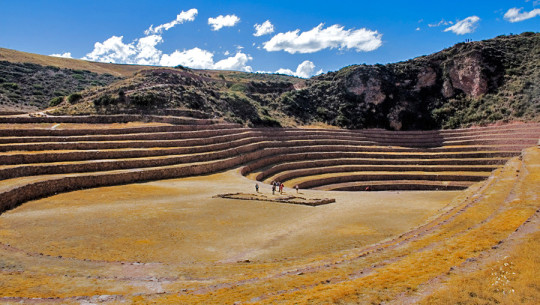
The archaeological group of Moray was recognized by the expedition Shirppe Johnson's in the year 1932, while flying over the area. The circular units of Moray are formed by platforms in the manner of concentric rings. Each circle includes a terrace that overlaps another, forming circles that expand. You can access from one to another by climbing outgoing stones, stuck in the wall.
According to the historian Edward Ranney, the Incas used the terraces of Moray that are isolated from the large settlements, as a place for special agriculture, perhaps for the development of their most precious crop: the coca leaf.
John Earls, for his part, claims to have discovered vertical stones on the terraces, the same ones that would mark the limits of the shadows of dusk during the equinoxes and solstices. The local people call these stones "ñustas". Earls concludes that each terrace in Moray reproduces the climatic conditions of different ecological zones of the Inca empire.
Due to its sheltered position, each of these platforms represents approximately one thousand meters of altitude under normal farming conditions. In its entirety, the complex would contain twenty or more miniature ecological zones. The site of Moray could also serve the Inca officers to calculate the annual production in different parts of the immense Tahuantinsuyo.
Even, it is known that the Incas produced in the terraces of Moray sixty percent of vegetable species, three thousand varieties of potatoes, corn, and many other species. In addition, it was an important center for the domestication, acclimatization and hybridization of wild species, which were adapted for human consumption.
Moray lends itself to many scientific controversies due to the fact that no serious investigations have been continued in this regard. The structures found here are typically Inca; although, some authors suggest that these are recent. One of the enigmas is the way how the water from the drain that flows through the aqueducts is worked; it is said that there must be underground channels built to allow water to flow. It is also said that being on top of a very porous natural stone formation enables the filtration of water, into the interior of the earth.
Between the months of September and October, hundreds of residents of the neighboring communities attend Moray's circular platforms to celebrate the Moray Raymi or Fiesta del Sol. The festivities include folkloric dances related to the land, products and agricultural work. Observations At 38 Kms northwest of Cusco and 7 Kms southwest of Maras, is the town of Moray. It is possible to arrive by car through the road that leaves the town.
DAY 1: CITY TOUR CUSCO
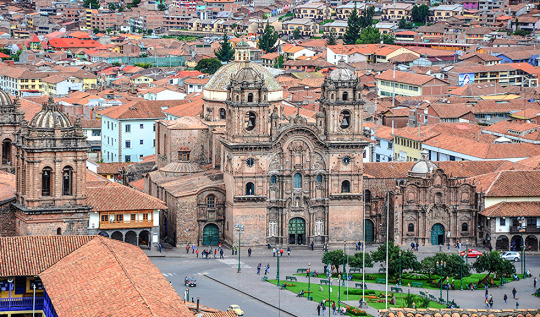
We'll be waiting for you at the airport in Cusco on your arrival date , take you to the hotel where you will rest for an hour , you'll have a cup of coca tea and we will pick you up from your Hotel in the afternoon (from 13:30 hrs to 18:30 hrs) to start with the tour around Cusco and outskirts. Tour around Cusco and outskirts: We pick you up from your Hotel to start visiting the following attractives , with aprofessional guide: - The Koricancha Palace andConvent of Santo Domingo Religious center known as "The Temple of the Sun" where you will admire the impressive engineering used in its construction. The Cathedral:Colonial religious monument of extraordinary artistic value. Sacsayhuaman: Located 3 km from the city of Cusco,impressive stone fortress monumental and magnificent architecture, famous for its enormous carved stones,some of which are at9 m/ 30 feettall and weigh of 350 tons. Here is where the Inty Raymi or Fiesta del Sol in June take place every year. Qenqo: Ceremonial and ritual center, amphitheater where sacrifices were made. Puca-Pucara: An old tambo (resting place), monitoring placethroughout the Inka Empire Routes. Tambomachay: At 7 Km. From the city of Cusco,ceremonial center of worship of water , traditionally known as the place of water.Excursiontime: around 5 hours. Frequency : everyday in the afternoons.
DAY 2: CUSCO - SACRED VALLEY OF THE INCAS
This day we take a trip to the Sacred Valley of the Incas: visit the Pisac Incas built, the colorful Andean market and the church. Then we pass places like Lamay and Calca on the way to arrive in Urubamba town where we stop for lunch. After lunch visit to Ollantaytambo town, where we can see its typical streets, the impressive archaeological constructions and agricultural terracing, not to mention the splendid views over the sacred valley. Finally, visit the picturesque Andean village of Chinchero where the built of the royal hacienda Of Tupac Inca Yupanqui lie. You can admire the well preserved Inca wall in the main square, and visit the beautiful colonial temple. Built on Inca foundations with interesting paintings. Overnight in Cusco
DAY 3: CUSCO - MACHUPICCHU
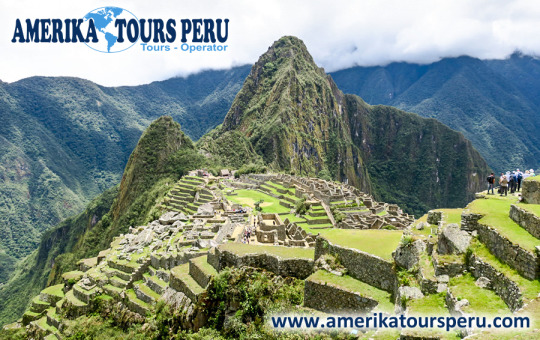
Pick up at the hotel to take the train for a full day tour of the Magical citadel of Machu Picchu, it is 112 Km. from Cusco .During the journey we see the Urubamba canyon, Urubamba River and the show capped peaks of the Veronica Mountain. Arriving in Aguas Calientes we go to Machu Picchu where we visit this wonderful Inca Sanctuary also known as “The lost City of the Incas “one of the best known examples of surviving Inca. After the visit, we come back to Aguas Calientes to take the train back to Cusco.
DAY 4: DEPARTURE FROM CUSCO
We will pick you up from your hotel in Cusco and take you to the airport.
MACHU PICCHU TOUR IN CUSCO ITINERARY
If you want to learn more about Cusco, Sacred Valley, Maras-Moray and Machu Picchu, this package will let you learn about the great history of the Incas, and see many attractions from Inca times and of the Colony. This package is recommended for people of all ages.
DAY 1: CITY TOUR CUSCO
We'll be waiting for you at the airport in Cusco on your arrival date , take you to the hotel where you will rest for an hour , you'll have a cup of coca tea and we will pick you up from your Hotel in the afternoon (from 13:30 hrs to 18:30 hrs) to start with the tour around Cusco and outskirts. Tour around Cusco and outskirts: We pick you up from your Hotel to start visiting the following attractives , with aprofessional guide: - The Koricancha Palace andConvent of Santo Domingo Religious center known as "The Temple of the Sun" where you will admire the impressive engineering used in its construction. The Cathedral:Colonial religious monument of extraordinary artistic value. Sacsayhuaman: Located 3 km from the city of Cusco,impressive stone fortress monumental and magnificent architecture, famous for its enormous carved stones,some of which are at9 m/ 30 feettall and weigh of 350 tons. Here is where the Inty Raymi or Fiesta del Sol in June take place every year. Qenqo: Ceremonial and ritual center, amphitheater where sacrifices were made. Puca-Pucara: An old tambo (resting place), monitoring placethroughout the Inka Empire Routes. Tambomachay: At 7 Km. From the city of Cusco,ceremonial center of worship of water , traditionally known as the place of water.Excursiontime: around 5 hours. Frequency : everyday in the afternoons.
DAY 2: CUSCO - SACRED VALLEY OF THE INCAS
This day we take a trip to the Sacred Valley of the Incas: visit the Pisac Incas built, the colorful Andean market and the church. Then we pass places like Lamay and Calca on the way to arrive in Urubamba town where we stop for lunch. After lunch visit to Ollantaytambo town, where we can see its typical streets, the impressive archaeological constructions and agricultural terracing, not to mention the splendid views over the sacred valley. Finally, visit the picturesque Andean village of Chinchero where the built of the royal hacienda Of Tupac Inca Yupanqui lie. You can admire the well preserved Inca wall in the main square, and visit the beautiful colonial temple. Built on Inca foundations with interesting paintings. Overnight in Cusco
DAY 3: CUSCO - MACHUPICCHU
Pick up at the hotel to take the train for a full day tour of the Magical citadel of Machu Picchu, it is 112 Km. from Cusco .During the journey we see the Urubamba canyon, Urubamba River and the show capped peaks of the Veronica Mountain. Arriving in Aguas Calientes we go to Machu Picchu where we visit this wonderful Inca Sanctuary also known as “The lost City of the Incas “one of the best known examples of surviving Inca. After the visit, we come back to Aguas Calientes to take the train back to Cusco.
DAY 4: MARAS MORAY TOUR
We will start at 9:00 am with pick up from your hotel; we will go to the Quechua village of Chinchero where we will make a stop. This town is located 28 km outside of Cusco and is surrounded by patchwork style fields with exquisite natural colours. Chinchero is a charming town, with colonial style buildings and was a major agricultural center during the Tawantinsuyo. Here you can appreciate the stone walls with trapezoidal niches and a traditional market where locals still practice bartering. The women of Chinchero are easily recognized for their very distinguishing clothing and braided hair. We will go on to the picturesque town of Maras, 52 km from Cusco. It is located at an altitude of 3,380 meters above sea level. This is a small village famous for its salt mines which consist of about 3000 small wells with an average area of about 5m² from which salt is extracted after a drying process. The Salt mines, better known as “Salineras de Maras”, have been exploited since Inca times as a means of economic exchange. 7 km from Maras, we will visit the archaeological site of Moray. Here we will see the greatness of the circular terraces of Inca agriculture. Moray is a group of circular terraces which was used as an agricultural experimental center. The Incas used it to study the adaptation of plants to new ecosystems. The overlapping circular stone rings widen as they rise and it has a total depth of 150 m. After a guided tour, we will go back to Cusco. The tour lasts about 5 hours and ends at Regocijo Square (a half away block from the main square) at around 2:30 pm. Transfer to your hotel
DAY 5: DEPARTURE FROM CUSCO
We will pick you up from your hotel in Cusco and take you to the airport.