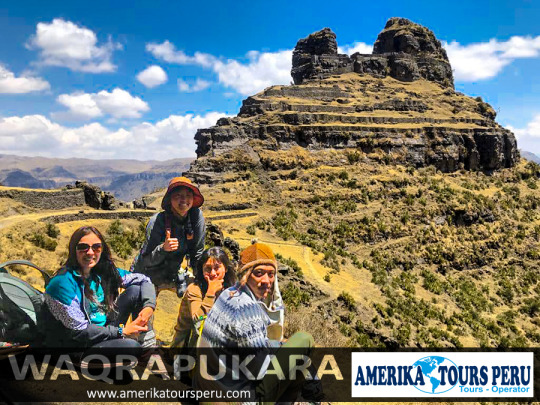
Waqrapukara is a new tourist attraction that remains almost unknown until today. The tour is suitable for those seeking a spirituality that is drowned in the sea of commercial tours. Waqrapukara is a pre-Inca archaeological complex located in the Acomayo province within the Cusco region, near the Apurímac River. The main construction is located on platforms, squares and a so-called «Bosque de Piedras». From its height of 4,140 meters above sea level, it offers spectacular views of the Apurímac River and the Andes.
WAQRAPUKARA TOUR ITINERARY
Its name comes from Quechua, "waqra" means horn, while "pukara" means fortress. Therefore, the meaning of the name translates as a "horned fortress" given by its typical form. However, the locals also called it "Llamapukara", as they claim that the shape does not represent horns, but ears of a lama.
It was built by the pre-Inca Qanchis culture in the period called "Auqaruna" (1,500 BC - 1,000 BC). During this period, the complex was a city called "Llaqta Pukara" and home to a leader of the Yankees. It also served as an astronomical observatory and sanctuary for the god "Teqci Pachakamaq Wiraqocha" (a creator of all created things). Subsequently, it was conquered by the Incas, who have molded the buildings to geography during the reign of Wayna Qhapaq. Then it became a first-class Inca sanctuary that symbolizes an immense political and religious power that has not yet been confused. In 2017, the complex was declared Cultural Heritage of the Nation by the Ministry of Culture of Peru.
Waqrapukara Archaeological Complex. Cultural Heritage of the Nation of 2017.
It was built by the Qinchas and later conquered by the Incas. The building is located on platforms, squares and a stone forest, it would be an Inca sanctuary. Waqrapukara has a privileged view of the Apurímac River.
Waqrapucara details
Maximum Altitude: 4,140 meters / 13,580 feet
Minimum Altitude: 3,096 meters / 10,157 feet
Duration of the walk: 6 hours
Trekking distance: 15 km / 9.3 miles
Difficulty: Moderate
Weather: Cold
Waqrapukara is the archaeological monument located in Acos, Acomayo province in Cuzco, which has been declared a National Cultural Heritage by the Vice Minister of Cultural Property. This Inca monument is located on the slopes of Mount Kenter, has a privileged view of the Apurímac River and has two groups of buildings.
The first group is located at the top, in the middle of a rocky dam, where you can see two enclosures separated by a wide central space. The enclosures have halls, ornamental niches and doors with double jambs; its architecture seems to be similar to that of other ceremonial buildings.
The second enclosure is located at the bottom, and has 8 platforms 153 meters long and 1.80 meters high, which correspond to the topography of the terrain.
Some inhabitants of Acos also call it Llamapukara; and although its origins go back to pre-Inca times, its foundations were built by the Q’anchi, and the Inca construction was built during the sovereign period of the Tahuantinsuyo Wayna Qhapaq. MORE CUSCO TOURS.
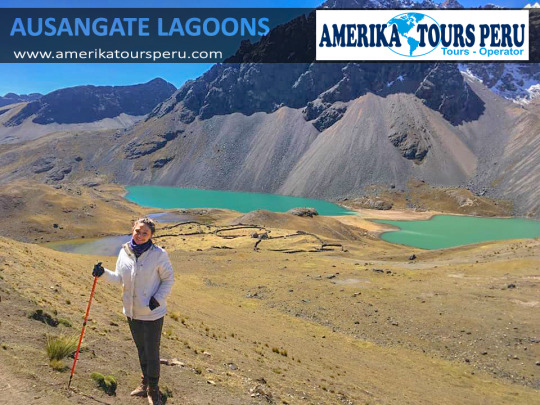
Ausangate is the representative mountain of the Andes of Cusco and Peru. It is located in the Vilcanota mountain range and is one of the most difficult areas to enter and that is very rare in Peru. Its main climate is 6,372 meters above sea level with large lagoons with a bright green / blue color. In addition there are rocks that make the area like a paradise and very modern. The Trek Ausangate is an indescribable adventure, and it is impossible not to be impressed by the enormous beauty of eternal snow. Often you will find stones at a height of more than 5000 meters and also rocks covered with ice tongues that when thawing, extending in magnificent ways forming ice lagoons. The Ausangate trek is one of the tourist destinations in Cusco.
AUSANGATE LAGOONS ITINERARIO.
In the Inca mythology of this mountain and the nearby lakes - among which Sibinacocha stands out - the male energy is born that fertilizes the mother earth Pachamama, after a long flow, the waters are lost in the unknown lands of the Amazon to return, to fill the lakes and glaciers every night turned into the river of stars or Willkamayu known in the west as the Milky Way The Community of Chillca made up of shepherds of llamas and alpacas is known as the guardian of these pristine places, from where it can be done mountain walks spending the night in comfortable hostels or tambos, among which Machuracay Tambo stand out, in a trek called "Camino del Apu Ausangate".
Every year on the north side of Ausangate the feast of Quyllur Rit'i (Quechua: "star snow") is celebrated before the feast of Corpus Christi, during which thousands of Quechua pilgrims to the Lord of Quyllur Rit'i in the church from Sinakara. Snowy Ausangate normally takes a 7-day tour, it is an adventure that no one should miss.
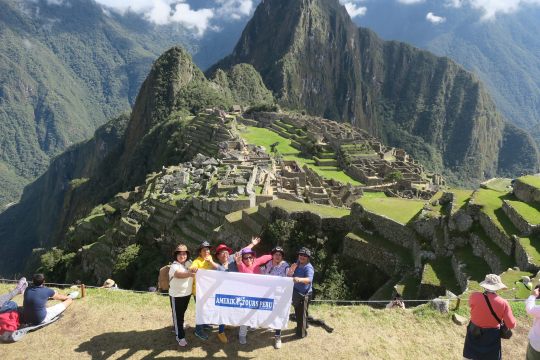
The llaqta (city) of Machupicchu is an Inka political, religious and administrative center, which includes temples, platforms, houses and water channels.
Where it is located? The llaqta of Machupicchu is located in the district of Machupicchu, province of Urubamba, of the Cusco region, at the height of km. 112.5 of the railway line and it was a graben between the mountains of Machupicchu and Waynapicchu.
History and architecture Built during the first half of the fifteenth century, Machupicchu is divided into two large areas: the agricultural one that comprises a vast network of artificial terraces or terraces, and the urban one formed by various constructions and squares among which the temples of the Sun, of the Three Windows, of the condor and the main temple.
Important data: - The Historic Sanctuary - Machupicchu National Archaeological Park was included in the UNESCO World Heritage List as a mixed cultural and natural heritage, due to its exceptional universal value, considered as an important political, religious and administrative center of the Inca era.
- Its temperature ranges between 6.2 ° C 29.5 ° C, since it is located in a subtropical zone. Its rainiest months are from November to March.
- Its majestic architecture comprises about 140 structures throughout the Inka llaqta.
- The average altitude of the llaqta is 2 450 m.a.s.l.
- His scientific discovery is attributed to the researcher Hiram Bingham, who was in search of the last capital of the Incas of Vilcabamba.
- Machupicchu was declared "Historic Sanctuary of Peru" in 1981. General data
Machupicchu means old mountain, named for the location of the llaqta inka.
The architectural complex was built in the mid-fifteenth century and according to historians it would have been built at the request of the Pachakuteq inka.
The exact location is in the Machupicchu Pueblo district, province of Urubamba, 112.5 km northeast of the city of Cusco.
Machupicchu was interconnected with the entire Inka empire through the Qhapaq Ñan, known as the Inka Road Network.
Its annual temperature is 6.2º C minimum and maximum of 29.5º C.
The llaqta of Machupicchu has two defined zones: agricultural zone formed by the platforms and terraces, and the urban zone that fulfilled administrative functions.
The average altitude of the llaqta is 2,450 meters above sea level.
The mountains of Waynapicchu and Machupicchu are ideal for panoramic photographs of the entire archaeological complex.
Entrance Tickets Due to the growing flow of tourists who wish to visit the Machu Picchu Inka Llaqta and to ensure that their experience is memorable, it is recommended to organize the visit well in advance, for which the following should be taken into account:
• Buy tickets to enter Machupicchu in advance, for limited daily capacity, check availability at www.machupicchu.gob.pe (only official page). • In case you cannot make your purchase through the website you can make it in person at the ticket offices of the Deconcentrated Directorate of Culture Cusco - DDC, located at Calle Maruri N ° 340 (Palacio Kusicancha) and Calle Garcilaso s / n (side of the Regional Historical Museum) from Monday to Saturday between 07:00 - 19:30 hours (does not attend holidays). The sale of admission tickets is subject to availability. • The Decentralized Directorate of Culture in Machupicchu Pueblo is the last point of sale, so a last minute purchase will mean subject to the availability of remaining spaces in the system, also the payment is only in soles and cash. Credit cards, debit cards or payment in dollars are not accepted. • The purchase of a student ticket is in person or through a travel agency prior to the presentation or remission of a valid student card. ISIC card is not accepted. • Entry to SHM - PANM is from the time indicated on the ticket, so early admission is not allowed. • Bring printed the entrance ticket to Machupicchu. • Before entering the llaka inka make use of the hygienic services, since the visit will last an average of 2 to 4 hours (There are no hygienic services within the llaqta). • Re-entry is only allowed for visitors who have a visit to the mountains of Machupicchu and Waynapicchu, and entrance tickets for the mountains can be purchased in advance through the website www.machupicchu.gob.pe, they are also subject to availability, taking into account that the maximum allowed entry capacity is 400 visitors per day for each mountain, divided into two groups of 200 visitors per shift.
If you do not have much time to be in Cusco Express Tour 3 Days is the ideal option one for you. You will know the most important sectors of the city of Cusco and inca citadel Of Machu Picchu.