During the time of the Incas there was a great network of roads called “Camino Real” to unite the Inca empire. However, due to its rugged geography many places were joined by suspension bridges made of vegetable fiber.
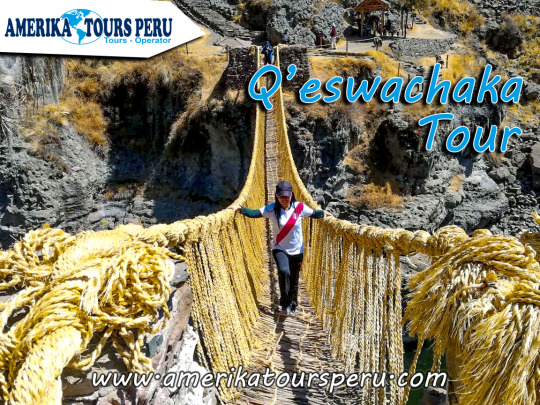
The Qeshuachaca is the only bridge that has been renovated from generation to generation by the families of Cusco until today. The bridge is located in the department of Cusco, over the Apurimac River at 3,700 m.a.s.l. About a thousand people from different communities, near the bridge, meet for four days to renew it.
Now, we will know the four days of tradition that delays the reconstruction of Queshuachaca: On the first day, the inhabitants of the communities leave in search of a solid straw of vegetable fiber called Ichu in Quechua. Once the necessary amount of Ichu has been collected, the women weave this solid straw to form the ropes of the bridge, and the men are in charge of joining the rope from end to end and then braid it.
When the second day arrives, the structure of the old bridge is taken apart, the stone nails that support the bridge are removed, and four ropes are placed, which are the base of the structure of the new bridge. Tired, but with strength, on the third day, the villagers conclude with the assembly of the handrails and the bridge surfaces where the communities will cross.
Queshuachaca Tour And finally, on the fourth day, they celebrate the reconstruction of the bridge to the sound of music with native dances, since the work is considered as a holiday by Peruvian ancestors.
The Sacred Valley for the Incas With the river feeding the valley, its fertile lands were one of the main centers of food production during the time of the Incas; Some places, such as Moray, were used as agricultural laboratories, to experiment with species of plants brought from across the empire. The Incas cultivated potatoes, white corn, coca, fruits and vegetables, on terraces like those that can be seen in many valley villages specially designed for this purpose. Today the valley produces lucuma, peach, avocado, and one of the best corn grains in the world.
But it was more than just an important agricultural center; The Urubamba River Valley, "Willcamayu" for the Incas, was one of the most important elements in the religious cosmology of the Incas. They believed that the flow of the Urubamba was closely linked to constellations and mountains, they also believed that it was the counterpart of the milky way on earth.
information: Machu Picchu Tour
Where is the Sacred Valley of the Incas? The Urubamba river valley or "Sacred Valley of the Incas", is located 15 km northeast of the city of Cusco, is reached by a paved road. A trip by car to one of the nearest villages will take around 40 minutes. From there you can move to the other villages in the valley. What is the weather like in the valley? The Sacred Valley of the Incas is 2,800 m.s.n.m., 600 meters below Cusco, and enjoys one of the best climates in this region, daytime temperatures vary between 19 ° and 24 ° C. This privileged climate made the Incas take it as their main center of agricultural production, experimentation and research. Nowadays, travelers use the valley to acclimatize themselves, before starting their tours through Cusco and Machu Picchu, and without a doubt one of the best ways to avoid altitude sickness. What to see in the Sacred Valley of the Incas? Known by the Incas as Willcamayu, the beautiful valley extends from the town of Pisac to Ollantaytambo, along the Urubamba river. The ancient Inca settlements in these cities are presented as checkpoints, before entering the "Inca Trail" that leads to the sacred city of the Incas, Machu Picchu; They are simply amazing, and one of the best before what you will see in wonder. Pisac The town of Pisac is located 33 kilometers from the city of Cusco and is presented as the door to the Sacred Valley. It is world famous for its craft market and its impressive archaeological remains, located on a mountain above the town. This town was a kind of capital of the region in the time of the Incas, very important for its excellent location and its fertile lands. The Inca and colonial constructions that are exhibited in its territory, are admirable for its great bill and for the platforms that surround the mountains and polished stone structures, assembled to perfection. On the other hand, the people of Pisac has become the spiritual center of the Sacred Valley, in it you can have all kinds of experiences and spiritual retreats, in addition to meeting people from all over the world interested in this. Urubamba Urubamba is one of the most important cities in the valley today, it is a city that was born during the colony and is considered the world capital of corn. This is possible because it is watered by numerous rivers that are born in the peaks of the glacial mountains; This whole territory was highly appreciated by the Incas due to the fertility of their lands and the great qualities for cultivation. It is one of the best places to relax in the valley, you will see many foreigners, but beware, they are not tourists, they are people who left their countries and decided to stay in this cozy town. Ollantaytambo Ollantaytambo, also known as Ollanta, is located 97 km northwest of the city of Cusco; approximately 2 hours and 30 minutes by car. It was during the time of the Incas a fortified city, with temples, urban, agricultural and defense walls. It is known that the Inca city of Ollantaytambo served as an administrative checkpoint. After the Spanish invasion, it became one of the favorite places of the viceroys. It is considered one of the most important archaeological sites in Peru and South America; In addition, many people consider that after Machu Picchu, the town and the ruins of Ollantaytambo contain the most impressive Inca stone work in Peru; However, it is not the only amazing thing about this place. Only a few years ago, global positioning systems allowed us to discover that Ollantaytambo is aligned with other ancient constructions throughout the world; the pyramids of Gíza, the Easter islands, the Nazca lines, are just some of them; In addition, the most important archaeological remains around the world are aligned around this line. We recommend you visit the Inca city of Ollantaytambo, otherwise, you will be missing out on something very big. Chinchero On a normal tour of the Sacred Valley of the Incas, the town of Chinchero will be the one you will visit after touring most of the valley, back to Cusco; It is located 28 km from the city of Cusco at 3,772 m.a.s.l. and it has important archaeological sites, a beautiful 17th-century colonial church with canvases of the "Cuzqueña School", and a typical market where bartering can still take place.
MARAS AND MORAY TOUR
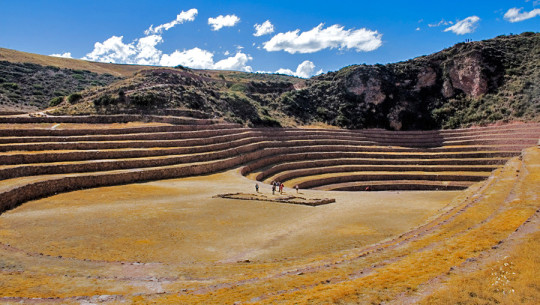
Moray is Quechua word and names a territorial sector occupied since time immemorial by the peasant communities of Mullak'as and Misminay.
The archaeological group of Moray was recognized by the expedition Shirppe Johnson's in the year 1932, while flying over the area. The circular units of Moray are formed by platforms in the manner of concentric rings. Each circle includes a terrace that overlaps another, forming circles that expand. You can access from one to another by climbing outgoing stones, stuck in the wall.
According to the historian Edward Ranney, the Incas used the terraces of Moray that are isolated from the large settlements, as a place for special agriculture, perhaps for the development of their most precious crop: the coca leaf.
John Earls, for his part, claims to have discovered vertical stones on the terraces, the same ones that would mark the limits of the shadows of dusk during the equinoxes and solstices. The local people call these stones "ñustas". Earls concludes that each terrace in Moray reproduces the climatic conditions of different ecological zones of the Inca empire.
Due to its sheltered position, each of these platforms represents approximately one thousand meters of altitude under normal farming conditions. In its entirety, the complex would contain twenty or more miniature ecological zones. The site of Moray could also serve the Inca officers to calculate the annual production in different parts of the immense Tahuantinsuyo.
Even, it is known that the Incas produced in the terraces of Moray sixty percent of vegetable species, three thousand varieties of potatoes, corn, and many other species. In addition, it was an important center for the domestication, acclimatization and hybridization of wild species, which were adapted for human consumption.
Moray lends itself to many scientific controversies due to the fact that no serious investigations have been continued in this regard. The structures found here are typically Inca; although, some authors suggest that these are recent. One of the enigmas is the way how the water from the drain that flows through the aqueducts is worked; it is said that there must be underground channels built to allow water to flow. It is also said that being on top of a very porous natural stone formation enables the filtration of water, into the interior of the earth.
Between the months of September and October, hundreds of residents of the neighboring communities attend Moray's circular platforms to celebrate the Moray Raymi or Fiesta del Sol. The festivities include folkloric dances related to the land, products and agricultural work. Observations At 38 Kms northwest of Cusco and 7 Kms southwest of Maras, is the town of Moray. It is possible to arrive by car through the road that leaves the town.
DAY 1: CITY TOUR CUSCO
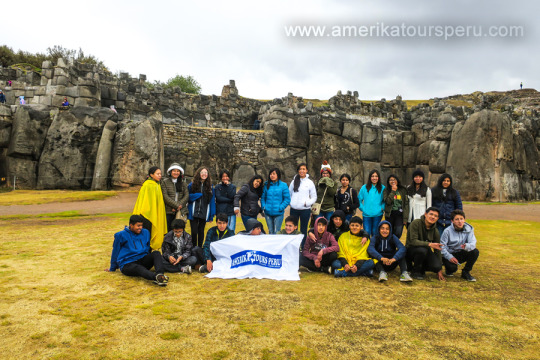
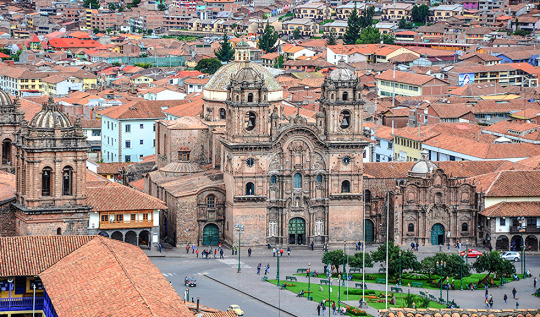
We'll be waiting for you at the airport in Cusco on your arrival date , take you to the hotel where you will rest for an hour , you'll have a cup of coca tea and we will pick you up from your Hotel in the afternoon (from 13:30 hrs to 18:30 hrs) to start with the tour around Cusco and outskirts. Tour around Cusco and outskirts: We pick you up from your Hotel to start visiting the following attractives , with aprofessional guide: - The Koricancha Palace andConvent of Santo Domingo Religious center known as "The Temple of the Sun" where you will admire the impressive engineering used in its construction. The Cathedral:Colonial religious monument of extraordinary artistic value. Sacsayhuaman: Located 3 km from the city of Cusco,impressive stone fortress monumental and magnificent architecture, famous for its enormous carved stones,some of which are at9 m/ 30 feettall and weigh of 350 tons. Here is where the Inty Raymi or Fiesta del Sol in June take place every year. Qenqo: Ceremonial and ritual center, amphitheater where sacrifices were made. Puca-Pucara: An old tambo (resting place), monitoring placethroughout the Inka Empire Routes. Tambomachay: At 7 Km. From the city of Cusco,ceremonial center of worship of water , traditionally known as the place of water.Excursiontime: around 5 hours. Frequency : everyday in the afternoons.
DAY 2: CUSCO - SACRED VALLEY OF THE INCAS
This day we take a trip to the Sacred Valley of the Incas: visit the Pisac Incas built, the colorful Andean market and the church. Then we pass places like Lamay and Calca on the way to arrive in Urubamba town where we stop for lunch. After lunch visit to Ollantaytambo town, where we can see its typical streets, the impressive archaeological constructions and agricultural terracing, not to mention the splendid views over the sacred valley. Finally, visit the picturesque Andean village of Chinchero where the built of the royal hacienda Of Tupac Inca Yupanqui lie. You can admire the well preserved Inca wall in the main square, and visit the beautiful colonial temple. Built on Inca foundations with interesting paintings. Overnight in Cusco
DAY 3: CUSCO - MACHUPICCHU
Pick up at the hotel to take the train for a full day tour of the Magical citadel of Machu Picchu, it is 112 Km. from Cusco .During the journey we see the Urubamba canyon, Urubamba River and the show capped peaks of the Veronica Mountain. Arriving in Aguas Calientes we go to Machu Picchu where we visit this wonderful Inca Sanctuary also known as “The lost City of the Incas “one of the best known examples of surviving Inca. After the visit, we come back to Aguas Calientes to take the train back to Cusco.
DAY 4: DEPARTURE FROM CUSCO
We will pick you up from your hotel in Cusco and take you to the airport.