What does Choquequirao mean?
Choquequirao is a Quechua word that means 'Cradle of Gold'. The name comes from the nomination of a hill near the archaeological site.
Where it is located? Choquequirao is located in one of the fringes of the snowy Salkantay, north of the Apurímac River. It is currently located in the Santa Teresa district, La Convencion province, Cusco department, Peru.
How high is it?
Choquequirao is located 3,033 meters above sea level (m.s.n.m.). Due to its location, it is presumed that this Inca enclosure served as a checkpoint between the main Inca sites such as Pisac, Cusco and Machu Picchu.
What's in Choquequirao? Choquequirao has only been excavated by 30%. Despite this, it already has several very important Inca buildings:
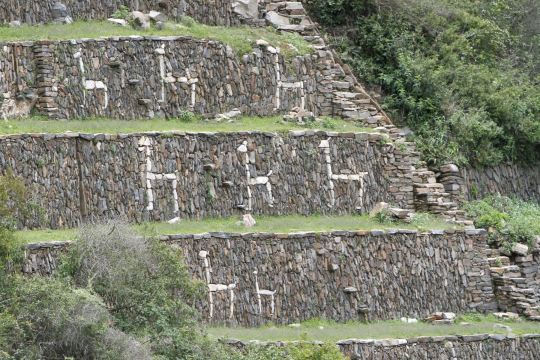
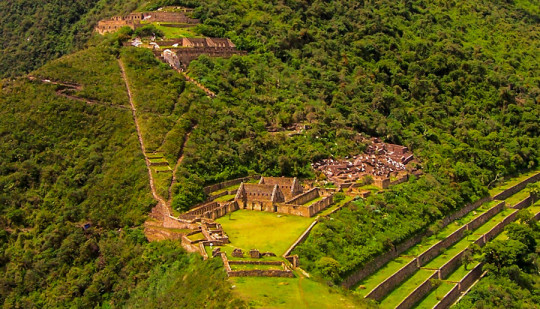
Main square - The main square or Huaqaypata divided the enclosure into two. It is a two-story stone construction. Along with this, there are other buildings connected to each other. Colcas - Typical constructions of the main Inca centers. In Choquequirao, these platforms have internal subdivisions. The purpose of these warehouses was to store products for food, clothing and others. Platforms - Choquequirao has a significant number of platforms for cultivation. In the western sector there are 22 engravings in the form of a flame arranged on 15 platforms. These figures are known as the 'Flames of the Sun'. Housing - In the highest part of Choquequirao, there are up to 5 buildings whose purpose was probably housing for the priests of the compound. This Inca site is believed to have been an important ceremonial center. Inca Cemetery - Also known as the 'Triumphal Wall'. There were found 17 funeral bundles and a water trough called "The House of the Fall of Water". Kallankas - These rectangular buildings had multiple functions such as workshop, administrative center, meeting space, etc. In Choquequirao there are 2 Kallankas on whose walls there were gutters that supplied water. Ushnu - This oval platform construction sits on top of a hill. Due to the wall that surrounds it and the privileged view of the snow-capped mountains, the river and the entire enclosure; it is believed to have had a religious purpose. How to get to Choquequirao? The only way to get to Choquequirao is by land. Currently, the main route is going to the town of Cachora (2,903 masl), 3 or 4 hours by road from the city of Cusco (2 hours from the city of Abancay).
There, the walk begins to the Inca archaeological site. The route through various important points such as Capuliyoc, Maranpata and Sunchupata. It is calculated that from Cachora, after 32 kilometers on foot, you reach Choquequirao.
The walking time from Cachora to Choquequirao on average is 10 to 12 hours. A cable car is currently being built that would significantly reduce this time.
How's the weather? The Choquequirao archaeological site is located at 3,033 meters above sea level. The climate is temperate with cold at night. However, the tourist will not stay in the Inca complex until after sunset.
However, the path leading to the top of Choquequirao is hot due to the proximity of the Apurímac canyon. The temperature at the archaeological site is calculated to vary between 5º C and 25º C.
What is the flora and fauna like in Choquequirao? Choquequirao is home to a diversity of animals and birds such as the condor, foxes, vizcachas, cougars, hummingbirds, spectacled bears and the cock of the rocks.In addition, like Machu Picchu, a great variety of orchids are concentrated there.
Choquequirao trekking route Choquequirao 4-day tour The most usual way to get to Choquequirao is through the trekking route of 4 days and 3 nights. You can hire this tour online or directly from an agency in the city of Cusco. Choquequirao Trek Information
We will pick you up from your Cusco hotel at 5.00 am in our transport, and then drive for 2 hours to Curahuasi (2909 m. / 9543 ft.), village where we will have breakfast, and then we continue to Capuliyoc, we arrive to nice view point called Capuliyoc (2915 m. / 9561 ft.), from here, we will have the privilege to see spectacular views of Padriyoc and Wayna Cachora snowcapped peaks (mountains over 5400 m.). At this point we will have some time to enjoy our snacks and we take some pictures of the breathtaking views of the river and the canyon stretching down the valley. From here we will descend through a unique zigzag path for 2 hours more to reach our place for lunch. Finally around 1 pm. we will have lunch. You have time to relax, put your feet up and have some refreshing tea, before we get ready to hike again for 2 hours more descending, so, we will reach our campsite located at Chiquisca (1836 m. / 6023 ft.) around 5 pm. where we will spend the night.
DAY 2: CHIQUISCA – MARAMPATA – CHOQUEQUIRAO RUINS
After our breakfast, we will leave early, throughout the day we will see a wide variety of bromeliads, orchids and stands of bamboo; we’ll also hope see birds such as Andean Quetzals, Toucans an a variety of hummingbirds. From our campsite we walk around 1 hour in order to descend to the bottom of the Canyon, called Playa rosalina and the magnificent Apurimac river (1550 m./ 5084 ft). From here we will begin probably the hardest section of the path due to the ascension; 2 hours steep climb to Santa rosa (2095 m. / 6873 ft.) where We will have time to take a refreshing break. From Santa rosa we will continue uphill for another 2 hours towards marampata (2913m / 9557ft), a flat ground where we can have a break and enjoy the views of Apurimac Canyon and the famous Inca site of Choquequirao. Here We’ll have lunch and take advantage of the facilities (toilets and wash room).After lunch We will continue to hike for another one hour to reach our campsite which is located just outside of the Great Inca Site Choquequirao (3110 m. / 10120 ft.) and We will spend the late evening in the ruins, where we will see a very nice sunset over mountains, and if we may be lucky enough to spot Condors soaring nearby over the valley below. Camping at Choquequirao campsite (bathrooms and cold water showers are available).
DAY 3: CHOQUEQUIRAO RUINS – CHOQUEQUIRAO PASS – MAIZAL
After our early breakfast we will visit the mysterious Inca site of Choquequirao, where our professional Tour Guide will explain about the history of this magnificent Inca site. Originally discovered in the 17th century by the Spanish, it lay abandoned and forgotten until recent years when tourism raised the profile of the city and exploration began. Even with this increased interest only 25% of the city has been explored and many of its secrets still wait to be discovered. Actually we can visit the most important zones such as the main plaza, the inca houses, the granaries, the ceremonial sector and its altars, the famous terraces, and the great Llama sector where Incas represented this sacred animal on their buildings. After our guiding visit, you have extra time to explore and enjoy the place by yourselves, after this, we continue with our trail, we will begin walking uphill until the highest point for this day called Choquequirao pass located at 3,300 masl. or 10,890 ft., then we will descend until to the deepest point of the small canyon known as White River or Río Blanco (1900m/6234f), On the way we will pass by Pinchiunuyoj, a small archaeological site. From Rio Blanco we will climb up for about 3 hrs. and during this time we will observe different species of birds, different varieties of orquids, and local coca plantations, we continue hiking until our campsite at the place called maizal (3000 masl. / 9900 ft.).
DAY 4: MAIZAL – SAN JUAN PASS – YANAMA
Today after a very good breakfast we will start a superb day’s hike on a path surrounded by vegetation and flowers climbing by 3 ½ hours along the way you will see evidence of mines that at one time were exploited, but are no longer used. As we continue and ascend, the weather will become a little colder and we will find the remains of an Inca trail. This trail will take us toward the pass called San Juan Pass (4200m/13,780ft). From this beautiful place you can see a great landscape with a grand chain of mountains such us Sacsarayoc, Pumasillo and Choquetecarpo, from which some of the latter peak more than 5000m/16404 feet. You will also see glaciers and many mountains that surround it. After some pictures and a break at the San Juan Pass, we’ll head down and in the distance another recently discovered Inca ruin, Corihuayrachina and the equally interesting old silver mines of Mina Victoria, and we continue Descending by 3 hours to the north into the River Yanama Valley, we follow a high trail which traverses steep slopes and provides another excellent opportunity to spot condors. We camp beside the river at the little Andean village of yanama (3530 m / 11,581 ft.). In the afternoon once again our cook will prepare a tea time for us and after a delicious dinner.
DAY 5: YANAMA – YANAMA PASS – TOTORA – COLPAPAMPA
After early breakfast, we make our way out of the Yanama valley, as we ascend we return to a more barren environment where only the local grasses and hardiest plants can survive. we will start climbing slowly to the highest point of the whole trek, this pass is known as yanama pass(4670 masl. or 15410 feet), again the view will be amazing from here, we will be surrounded by snowcapped mountains as the Sacsarayoj mountain and the Padreyoj mountain and if we are lucky we will even see a condor flying., After a small stop, from this pass we make our way down in to the valley and back in to warmer climes. About 1hour beyond the pass we arrive to a small community called totora at 3,630 masl. or 11,979 ft. where we will have our lunch. After lunch, during the afternoon, we will enjoy frequently the view of snowcapped mountains such as Salkantay (6264 m.) and Pintuyu (5450 m.) and we continue going down for another 2 hours to colpapampa (2750 m.) which is where we’ll be camping for the night; when we arrive you’ll notice a change – now that we’re nearly to Machu Picchu the communities are larger and more well supplied, there are also more tourists whom came from the route of the Salkantay trek and they converge at this point.
DAY 6: COLPAPAMPA – PLAYA SAHUAYACU
Our destination today is the village of La Playa about 12km down the valley from Colpapampa. Our route takes us along the Lluskamayo River through an area that is teeming with life and that has various coffee and fruit plantations. Tonight we will stay at the village of La Playa (2400m / 7874ft.) which is well connected and there are plenty of places where you can buy snacks and refreshments, you can also try some of the locally grown coffee. If you are interested there is the option to visit some hot springs that are close by, let your guide know in advance so that he can organise this for you.
DAY 7: LA PLAYA – HYDROELECTRIC STATION – AGUAS CALIENTES TOWN
Today is your last hiking day. It will end around lunch time. This climb along the Inca Trail takes about six hours. It is three hours uphill, along the hillside with great views of the Santa Teresa Valley and some coffee and passion fruit farms. Once we arrive at the top of this mountain, we will be at the famous Inca site of Llactapata, which was built by the Incas. They used it to observe the sunrise during the winter solstice. You will also see Machu Picchu for the first time from this location, as well as views of the surrounding areas, such as, the valleys and mountains of Machu Picchu (Huayna Picchu and Machu Picchu Mountains). Then, we will walk the last three hours, descending down to the hydroelectric station. Here, we will enjoy our last lunch and say goodbye to your trekking chef. You will retrieve your duffel bags and catch the train around 3:30 p.m. After a one hour ride to Aguas Calientes, you will be taken to your hotel for a hot shower. If you would like, you can visit the famous hot springs at Aguas Calientes (the entrance fee is $3 per person), then enjoy dinner at a restaurant.
DAY 8: AGUAS CALIENTES - MACHU PICCHU - CUSCO
This day will be for sure the most fascinating for you, because you will see Machupicchu in all its glory from dawn. We get up at 5:00 am and after our breakfast we will go to the bus station for boarding the first bus that leaving at 5:30 am to be in Machupicchu at 6:00 am. Inside Machupicchu we will have 2 hours guided tour where you will visit the most remarkable places such as: el torreón semicircular, el templo de las tres ventanas, el intihuatana, el templo del cóndor, la sala de los morteros y el baño del inca. Then you will have free time to explore Machupicchu by your own or descend to Aguas calientes (Lunch in not included). In the afternoon you will board the train from Aguas calientes to Ollantaytambo, place from where you will be transported by touristic bus to Cusco. Estimated arrival to Cusco (20:00 pm).
DAY 1: CUSCO – CACHORA – CAPULIYOC – SANTA ROSA.
Before the first daylight we jump on the car to transport at start to our adventure, breakfast in the Hotel around 5 am. likewise make sure bring all your own equipment to the trek. Then we will start with our journey to the village of Cachora from Cusco 4 hours drive to the trailhead of Cachora, continuing thereafter towards the Cunyac Bridge between the departments of Cusco and Apurimac, arriving at Cachora 2800 masl. and Capuliyoc 2900 masl at . Here we will meet with our horseman (donkey drivers), here is the first view to the Choquequirao complex still further, we starting with gentleman downhill by serpent trail over the Apurimac canyon for 4 hours, crossing the small hamlet and hut called Cocamasana and Chiquisca on the lower part of the valley, the climate is warm and sunny on the dry season is dusty, we will have lunch before the start the ascent towards Santa Rosa hamlet, lunch spot called Playa Rosalinda 1500 masl, after nap the ascent is around 2 hours till Sta Rosa 2100 masl. The first base camp. Choquequirao Trek Classic
DAY 2: SANTA ROSA – MARAMPATA – CHOQUEQUIRAO.
One day of complete adrenaline to climb up to the ancient city there are the highest view to the wide landscape, after light quake breakfast around 6:00 am, we will continue our hike up to Marampata 2850 m.a.s.l for around 3 hours slow pace. During our journey we will observe the dense vegetation in the area. Then we will arrive to Maranpata beside the Chunchumayo to refreshing and short rest. Along the way you°ll observe many orchids and colorful flowers as well as many birds and mammals, Marampata the beautiful base camp, lunch spot with top view much further into the mountains the great inca complej called “Choquequirao city” 3000 masl. From lunch is 2 hours hike along the Inca trail with impressive views to Choquequirao and surrounded the complex. On the afternoon recommended visit with less clouds and clear views to mountain ranges early darkness side down tents close to Choquequirao 2950 masl. Base camp.
DAY 3: CHOQUEQUIRAO – MARAMPATA – CHIQUISCA.
To wake up on the Andes it is delight to following Our instinct of path finders, quit breakfast will be on the wild life in Choquequirao is prize by sunrise and fill up of gladness, We will arrive at the archaeological site in time to enjoy the impressionist views of the deep canyons and maybe the opportunity to see a Condor flying near, we will walk towards of the Choquequirao archaeologicalcomplex, which is a one-hour walk to see the Choquequirao and where our guide and mystic knowledge you feel travel around the time, after 3 hours exploring the complex we start return way back to the begin by the same trail 2 hours down cross the Apurimac river and 1 hour up until Chiquisca. base camp.
DAY 4: CHIQUISQA – CAPULIYOC – CUSCO.
The last Andean breakfast is the biggest and special with the river noising, mostly time of the day is hat and up back to the begin, we will return along the same route to Capuliyoc 2800 masl., the slope back the way up appreciate the condors and some Andean life on the route and snowcapped mountains and turn the head, share the experience on the trek, we descended on the first day and which is a soft climb of two hours until the pass of Capuliyoc 2915 m.a.s.l. During our journey we will observe the exotic flora and fauna as well as sights of majestic snow-capped peaks and the impressive canyon of the Apurimac. After to get Capuliyoc where the Climbing path finishes we will have lunch Where is the last views to the apurimac valley and Choquequirao Trek Classic, in over all the climbing time is 4 hours approx.. to get towards Capuliyoc the end of the trek and lunch spot, In the afternoon we will drive a car back 5 hours to Cusco. Arriving around 6 p.m., passengers will be transferred to the hotel. End of the services.
DAY 1: CUSCO – CACHORA – CHIQUISCA
We will pick you up from your Cusco hotel at 5.00 am in our transport, and then drive for 2 hours to Curahuasi (2909 m. / 9543 ft.), village where we will have breakfast, and then we continue to Capuliyoc, we arrive to nice view point called Capuliyoc (2915 m. / 9561 ft.), from here, we will have the privilege to see spectacular views of Padriyoc and Wayna Cachora snowcapped peaks (mountains over 5400 m.). At this point we will have some time to enjoy our snacks and we take some pictures of the breathtaking views of the river and the canyon stretching down the valley. From here we will descend through a unique zigzag path for 2 hours more to reach our place for lunch. Finally around 1 pm. we will have lunch. You have time to relax, put your feet up and have some refreshing tea, before we get ready to hike again for 2 hours more descending, so, we will reach our campsite located at Chiquisca (1836 m. / 6023 ft.) around 5 pm. where we will spend the night.
DAY 2: CHIQUISCA – MARAMPATA – CHOQUEQUIRAO RUINS
After our breakfast, we will leave early, throughout the day we will see a wide variety of bromeliads, orchids and stands of bamboo; we’ll also hope see birds such as Andean Quetzals, Toucans an a variety of hummingbirds. From our campsite we walk around 1 hour in order to descend to the bottom of the Canyon, called Playa rosalina and the magnificent Apurimac river (1550 m./ 5084 ft). From here we will begin probably the hardest section of the path due to the ascension; 2 hours steep climb to Santa rosa (2095 m. / 6873 ft.) where We will have time to take a refreshing break. From Santa rosa we will continue uphill for another 2 hours towards marampata (2913m / 9557ft), a flat ground where we can have a break and enjoy the views of Apurimac Canyon and the famous Inca site of Choquequirao. Here We’ll have lunch and take advantage of the facilities (toilets and wash room).After lunch We will continue to hike for another one hour to reach our campsite which is located just outside of the Great Inca Site Choquequirao (3110 m. / 10120 ft.) and We will spend the late evening in the ruins, where we will see a very nice sunset over mountains, and if we may be lucky enough to spot Condors soaring nearby over the valley below. Camping at Choquequirao campsite (bathrooms and cold water showers are available).
DAY 3: CHOQUEQUIRAO RUINS – CHOQUEQUIRAO PASS – MAIZAL
After our early breakfast we will visit the mysterious Inca site of Choquequirao, where our professional Tour Guide will explain about the history of this magnificent Inca site. Originally discovered in the 17th century by the Spanish, it lay abandoned and forgotten until recent years when tourism raised the profile of the city and exploration began. Even with this increased interest only 25% of the city has been explored and many of its secrets still wait to be discovered. Actually we can visit the most important zones such as the main plaza, the inca houses, the granaries, the ceremonial sector and its altars, the famous terraces, and the great Llama sector where Incas represented this sacred animal on their buildings. After our guiding visit, you have extra time to explore and enjoy the place by yourselves, after this, we continue with our trail, we will begin walking uphill until the highest point for this day called Choquequirao pass located at 3,300 masl. or 10,890 ft., then we will descend until to the deepest point of the small canyon known as White River or Río Blanco (1900m/6234f), On the way we will pass by Pinchiunuyoj, a small archaeological site. From Rio Blanco we will climb up for about 3 hrs. and during this time we will observe different species of birds, different varieties of orquids, and local coca plantations, we continue hiking until our campsite at the place called maizal (3000 masl. / 9900 ft.).
DAY 4: MAIZAL – SAN JUAN PASS – YANAMA
Today after a very good breakfast we will start a superb day’s hike on a path surrounded by vegetation and flowers climbing by 3 ½ hours along the way you will see evidence of mines that at one time were exploited, but are no longer used. As we continue and ascend, the weather will become a little colder and we will find the remains of an Inca trail. This trail will take us toward the pass called San Juan Pass (4200m/13,780ft). From this beautiful place you can see a great landscape with a grand chain of mountains such us Sacsarayoc, Pumasillo and Choquetecarpo, from which some of the latter peak more than 5000m/16404 feet. You will also see glaciers and many mountains that surround it. After some pictures and a break at the San Juan Pass, we’ll head down and in the distance another recently discovered Inca ruin, Corihuayrachina and the equally interesting old silver mines of Mina Victoria, and we continue Descending by 3 hours to the north into the River Yanama Valley, we follow a high trail which traverses steep slopes and provides another excellent opportunity to spot condors. We camp beside the river at the little Andean village of yanama (3530 m / 11,581 ft.). In the afternoon once again our cook will prepare a tea time for us and after a delicious dinner.
DAY 5: YANAMA – YANAMA PASS – TOTORA – COLPAPAMPA
After early breakfast, we make our way out of the Yanama valley, as we ascend we return to a more barren environment where only the local grasses and hardiest plants can survive. we will start climbing slowly to the highest point of the whole trek, this pass is known as yanama pass(4670 masl. or 15410 feet), again the view will be amazing from here, we will be surrounded by snowcapped mountains as the Sacsarayoj mountain and the Padreyoj mountain and if we are lucky we will even see a condor flying., After a small stop, from this pass we make our way down in to the valley and back in to warmer climes. About 1hour beyond the pass we arrive to a small community called totora at 3,630 masl. or 11,979 ft. where we will have our lunch. After lunch, during the afternoon, we will enjoy frequently the view of snowcapped mountains such as Salkantay (6264 m.) and Pintuyu (5450 m.) and we continue going down for another 2 hours to colpapampa (2750 m.) which is where we’ll be camping for the night; when we arrive you’ll notice a change – now that we’re nearly to Machu Picchu the communities are larger and more well supplied, there are also more tourists whom came from the route of the Salkantay trek and they converge at this point.
DAY 6: COLPAPAMPA – PLAYA SAHUAYACU
Our destination today is the village of La Playa about 12km down the valley from Colpapampa. Our route takes us along the Lluskamayo River through an area that is teeming with life and that has various coffee and fruit plantations. Tonight we will stay at the village of La Playa (2400m / 7874ft.) which is well connected and there are plenty of places where you can buy snacks and refreshments, you can also try some of the locally grown coffee. If you are interested there is the option to visit some hot springs that are close by, let your guide know in advance so that he can organise this for you.
DAY 7: LA PLAYA – HYDROELECTRIC STATION – AGUAS CALIENTES TOWN
Today is your last hiking day. It will end around lunch time. This climb along the Inca Trail takes about six hours. It is three hours uphill, along the hillside with great views of the Santa Teresa Valley and some coffee and passion fruit farms. Once we arrive at the top of this mountain, we will be at the famous Inca site of Llactapata, which was built by the Incas. They used it to observe the sunrise during the winter solstice. You will also see Machu Picchu for the first time from this location, as well as views of the surrounding areas, such as, the valleys and mountains of Machu Picchu (Huayna Picchu and Machu Picchu Mountains). Then, we will walk the last three hours, descending down to the hydroelectric station. Here, we will enjoy our last lunch and say goodbye to your trekking chef. You will retrieve your duffel bags and catch the train around 3:30 p.m. After a one hour ride to Aguas Calientes, you will be taken to your hotel for a hot shower. If you would like, you can visit the famous hot springs at Aguas Calientes (the entrance fee is $3 per person), then enjoy dinner at a restaurant.
DAY 7: AGUAS CALIENTES - MACHU PICCHU - CUSCO
This day will be for sure the most fascinating for you, because you will see Machupicchu in all its glory from dawn. We get up at 5:00 am and after our breakfast we will go to the bus station for boarding the first bus that leaving at 5:30 am to be in Machupicchu at 6:00 am. Inside Machupicchu we will have 2 hours guided tour where you will visit the most remarkable places such as: el torreón semicircular, el templo de las tres ventanas, el intihuatana, el templo del cóndor, la sala de los morteros y el baño del inca. Then you will have free time to explore Machupicchu by your own or descend to Aguas calientes (Lunch in not included). In the afternoon you will board the train from Aguas calientes to Ollantaytambo, place from where you will be transported by touristic bus to Cusco.
Estimated arrival to Cusco (20:00 pm).
This abandoned city has lots of similarity with Machu Picchu and there are a variety of theories about its origin. It is relatively clear, it is said that there are many areas to discover, so visiting it is a true adventure and mystery.
Choquequirao Trek to Machu Picchu is one of the most beautiful and interesting treks on offer in the Cusco. Following little visited pathways and one Inca Trail, beautiful scenery, this trek has it all !!! The trek begins following the regular route for Choquequirao and and continue through different paths until you reach Machu Picchu.